
The £38,000 squeeze threatening small housebuilders
11 November 2026
·
Liz Barclay
Share:
Britain cannot build if small builders cannot make it pay
Planning permission cannot pay the bricklayer or cover another jump in building costs. Small housebuilders need schemes that add up, and a new housing report warns that rising costs are making that harder. If ministers want more homes, they must give the firms building them a workable business case.
THE £38,000 SQUEEZE ON NEW HOMES
Small and micro house builders are staring down the barrel of a cost crisis that is reshaping the UK’s construction landscape. A new Prosper UK Housing Commission report, led by former housing minister Gavin Barwell, shows that regulation, tax and policy changes now add more than £38,000 to the cost of every new home compared with 2020.
Add in the inflation on labour and materials, and the total cost increase hits £76,000 per home. That’s a figure that’s pushing schemes into the red and forcing many small builders to scale back, stall projects or get out of the housebuilding game entirely.
The Cost Burden
The Commission’s breakdown shows how quickly costs have spiralled:
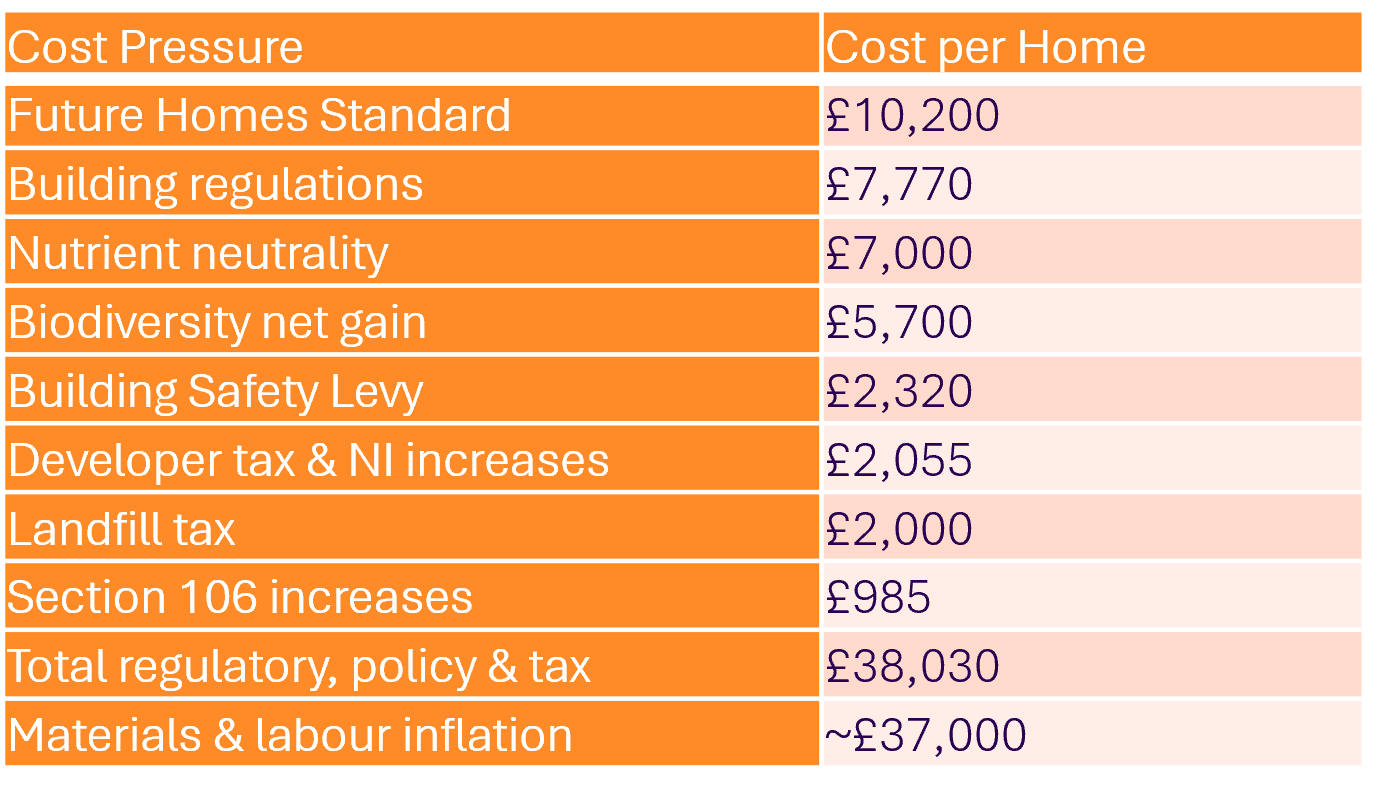
For small and micro builders who operate on tight margins, limited cashflow and local supply chains, these costs are an absolute nightmare. They can’t absorb them and they’re diving firms out of business. The corresponding nightmare for the government and the Chancellor is that without small housebuilders and the micro businesses that supply and work with them the UK can’t build.
Viability is collapsing
A scheme that made sense in 2020 may now be impossible to deliver. The Commission cites a 300‑home build‑to‑rent scheme that would have made £8m profit in 2020 but today would generate a £6m loss. Small builders don’t have the balance sheets to absorb losses and when viability collapses, they have no choice but to stop building.
Cashflow is breaking
Every new regulatory requirement adds more upfront cost, admin, delays and risk. Small builders often fund early stages of developments themselves. £38,000 extra per home destroys cashflow planning and there’s no chance of building reserves against the next economic shock.
Planning permission is meaningless
Even if small builders get planning consent, they can’t afford to build the homes. The report warns that speeding up planning won’t matter if the cost of building consented homes keeps rising, and this is already happening across England.
 Photographer Phil Hearing Unsplash photo ID qwltbMlICgs
Local housing supply is shrinking
Small builders deliver rural homes, infill developments, small sites, local regeneration and specialist housing. When they stop building, entire communities lose supply and local housing markets tighten meaning prices go up but getting a mortgage you can afford is becoming more difficult too.
Skills and capacity are being lost
Small firms train apprentices, retain local tradespeople and support regional supply chains. When projects stall bricklayers, carpenters and subcontractors leave and there’s fewer opportunities for apprentices. That all causes long‑term damage. There’s no one to hire when the work starts to come through again.
Small builders are being priced out by large developers
Big developers can absorb regulatory costs. Small builders can’t. This accelerates market concentration and reduces competition and innovation. Regional economies are hit hardest because small builders are the backbone of construction in rural areas and smaller cities. When they stop building, local economies lose jobs and investment and regenerations stalls, increasing regional inequality.
Small builders deliver one in three new homes in some regions. Their decline means fewer homes, higher rents, and worsening affordability. Construction is a major driver of GDP. If small builders stall, growth stalls and the government’s growth agenda is undermined. You cannot deliver growth without housing supply or deliver housing supply without viable small builders.
Barwell’s Commission Wants
A three‑year freeze on new regulatory burdens,
a review of existing burdens,
reform of biodiversity and nutrient neutrality rules,
a rethink of the Future Homes Standard, and
a joined‑up approach.
Barwell warns that boosting demand without boosting supply helps a few at the expense of everyone else and that’s a direct message to the Chancellor.
Squeezed Out
Small and micro builders are being crushed by a £38,000 regulatory squeeze that’s making new homes unviable. It’s not about avoiding standards but about making them deliverable. If the Chancellor wants growth, regional regeneration with healthy high streets, and a functioning housing market, he must heed the warnings of this report. Without small and micro builders, Britain simply won’t build.
Share: